Night – the breaking point of our sanity, the inevitable transformation from day to day, enveloping dusk, creating dawn – leaving the hopeless citizens of Sighet to question their values, their moral instincts, as God’s everlasting grace, no longer remains an essential building block of Jewish culture. As the Nazi’s continue to progress, working their way through Jewish communities, capturing, destroying, and exiling innocent victims as they go, author Elie Wiesel of the novel Night, paints pictures in the mind of the reader with beautiful imagery and crafted diction; in order to give a better understanding of the emotional journey the Jew’s encountered, when taken into the authoritative arms of the Germans.
Covering up their inhumane intentions, the German’s masked their sins with false accounts of sincerity. Wiesel brings attention particularly to an instance regarding a woman’s encounter with a German soldier on the home front. After moving in with the woman and her family, Wiesel states that he had heard, “he was a charming man, calm, likeable, and polite” (10). Three days after moving in, the soldier had purchased a box of chocolates for the Jewish woman, presenting himself as a respectable human being, without evil ever taking capacity in his twisted mind. Only days later, “two ghettos were created in Sighet” (11). The Jew’s took this as a grain of salt. Maybe this was for the better? After all they were still all together weren’t they? It wasn’t until the Germans took severe action, placing Jew’s in cattle cars as if they were the animals themselves, taking them to an unknown place where they all were to face their final solution – death. Throughout this section of the novel, regarding the departure from their homes and their arrival at Auschwitz, Wiesel’s simple, yet powerful diction helps to illustrate the reactions of the people and their surroundings. Their greeting was not from those who worked there, but rather “the smell of burning flesh” (28). The burning, the killing, the mass murder of their own kind, represents the descent to savagery the Nazi party must have endured in order to find pleasure in such inhumane anguish.
Wednesday, April 4, 2012

What does it mean to be an adult?
Growing up, innocence overtakes youthful minds, creating dreamlike versions of reality. Everything is perfect and nothing could possibly go wrong, for the toughest decision that had to be made was who would be today’s playmate at recess, or what color crayon would successfully complete the latest masterpiece. This innocence however, slowly begins to fade, as magic no longer remains the center of creation. In the novel All Quiet on the Western Front, Erich Remarque proposes the question as to what was the cause of this loss of youthfulness. What could have possibly transformed easygoing children into savages on their road to adulthood? Remarque’s character development makes it clear that the reactions to traumatic experiences and possible hardships along the way remain the main factor that truly separates the boys from the men.
Paul, a boy nearing the end of his teenage years, takes his love for his country to the battlefield, risking his life as he chooses to do so. “[He] [is] twenty years old; yet [he] [knows] nothing of life but despair, death, fear, and fatuous superficiality cast over an abyss of sorrow.” (263) Upon enlisting in the war, Paul never thought that a lack of food, painful wounds, and death of not only the enemy, but comrades as well, would come along with it. He drives himself nearly to insanity as he soon becomes comfortable with the sins that he is committing. While on the front he experiences his first true killing stating, “This is the first time I have killed with my hands, whom I can see close at hand, whose death is my doing.” (221) Granted, “Life is short;” (139) however, when it comes to an end, which would a soldier rather have flash before his eyes? His great memories? Or rather the murders and wrong actions that he has achieved? These experiences and the process of acceptance afterwards is what illustrates the level of maturity necessary in order to successfully complete the transformation from childhood to adulthood, a transformation that Paul and the rest of the men in his unit, have greatly failed.
Paul, a boy nearing the end of his teenage years, takes his love for his country to the battlefield, risking his life as he chooses to do so. “[He] [is] twenty years old; yet [he] [knows] nothing of life but despair, death, fear, and fatuous superficiality cast over an abyss of sorrow.” (263) Upon enlisting in the war, Paul never thought that a lack of food, painful wounds, and death of not only the enemy, but comrades as well, would come along with it. He drives himself nearly to insanity as he soon becomes comfortable with the sins that he is committing. While on the front he experiences his first true killing stating, “This is the first time I have killed with my hands, whom I can see close at hand, whose death is my doing.” (221) Granted, “Life is short;” (139) however, when it comes to an end, which would a soldier rather have flash before his eyes? His great memories? Or rather the murders and wrong actions that he has achieved? These experiences and the process of acceptance afterwards is what illustrates the level of maturity necessary in order to successfully complete the transformation from childhood to adulthood, a transformation that Paul and the rest of the men in his unit, have greatly failed.
Monday, March 12, 2012
O Earth - Response to page 55
Author’s Note: After reading chapter 4 in Erich Maria Remarque’s novel, All Quiet on the Western Front, I was particularly inspired by the last three paragraphs on page 55. Remarque’s diction and beautiful imagery help to create a heavenly sanctuary for the soldiers, when in reality it is quite the opposite. The beauty of war; however, was not the main point that I took out of the reading. The fact that as life nearly flashes before one’s eyes, as life’s end draws near on the battle field; one must take a moment to realize the blessings that life brings along with it and take notice of even the smallest of details. That was my inspiration because that is what holds the truth. The breathtaking imagery on this page also inspired me to include a mimic line and I hope I may do Remarque even the smallest bit of justice.
Gun shots firing, gas masks flying, soldiers throwing themselves upon the barren ground; I run for cover. Desperately seeking even the smallest bit of shelter, a grave, a hole, a body, to protect me from the savages that maneuver the fields before me; to protect me from the savages who run frantically, killing everything in sight, only in hopes to save themselves. This is not how war should be! Soldiers should be ones to help, to save, to heal. Not ones to simply slaughter all of mankind!
I find refuge in a rundown home, for now a safe haven from the evilness that progresses about me and soon find that I, myself am not the only one. A British soldier stares blankly back at me, slowly raising his gun – his only protection – from the dirt floor, and aims as I reach to do the same. He is no match for me: smaller, shorter, and much weaker. He is clearly not a product of German boot camp. I prepare for fire as I feel a shot from behind. Tumbling down, I turn to see yet another British soldier breathing in the smoke from his own gun. O Earth, thou receives back one of your own powerless men after short-lived life. Embrace me in your loving arms and catch me as I fall back into you. Wrap me in your warm caress and find in me new life. Forgive me for all my sins, for I know that I have failed you.
“O Earth, thou grandest us the great resisting surge of new-won life.” (55)
Gun shots firing, gas masks flying, soldiers throwing themselves upon the barren ground; I run for cover. Desperately seeking even the smallest bit of shelter, a grave, a hole, a body, to protect me from the savages that maneuver the fields before me; to protect me from the savages who run frantically, killing everything in sight, only in hopes to save themselves. This is not how war should be! Soldiers should be ones to help, to save, to heal. Not ones to simply slaughter all of mankind!
I find refuge in a rundown home, for now a safe haven from the evilness that progresses about me and soon find that I, myself am not the only one. A British soldier stares blankly back at me, slowly raising his gun – his only protection – from the dirt floor, and aims as I reach to do the same. He is no match for me: smaller, shorter, and much weaker. He is clearly not a product of German boot camp. I prepare for fire as I feel a shot from behind. Tumbling down, I turn to see yet another British soldier breathing in the smoke from his own gun. O Earth, thou receives back one of your own powerless men after short-lived life. Embrace me in your loving arms and catch me as I fall back into you. Wrap me in your warm caress and find in me new life. Forgive me for all my sins, for I know that I have failed you.
“O Earth, thou grandest us the great resisting surge of new-won life.” (55)
Friday, March 9, 2012
Living in the Unknown
Author's Note: I wrote this piece from the perspective of a soldier from the novel All Quiet on the Western Front. The boys came into the war not expecting it to turn out the way that it did. They believe that now that they are off at war, they are superior to all those around them, when in reality they are just 18 year old boys, who rid themselves of their innocence and thrust themselves into experience with the constant death, and gruesomeness that surrounds them. The power thirsty men that they take shelter with, help them to create images of a peaceful meadow to take away from their brutal surroundings; each of these occurrences inspiring my response from chapters 1-3.
Along to war I take, a gun, my dignity,
The life I chose to make
A greenhorn on the battle field
My imagination remains my most powerful shield
Creating perfect pictures of the life I wish to live,
Swaying grasses, clear blue skies,
A gift that nature continues to give
Yesterday at home - loved, and sheltered,
I left, leaving my innocence behind
Opening new doors,
New opportunities,
Opening new eyes
Men whom I have grown to hate,
Power thirsty savages determining their own fate
Sickness spreading, diseases unknown
Please dear lord, let me go back home.
Along to war I take, a gun, my dignity,
The life I chose to make
A greenhorn on the battle field
My imagination remains my most powerful shield
Creating perfect pictures of the life I wish to live,
Swaying grasses, clear blue skies,
A gift that nature continues to give
Yesterday at home - loved, and sheltered,
I left, leaving my innocence behind
Opening new doors,
New opportunities,
Opening new eyes
Men whom I have grown to hate,
Power thirsty savages determining their own fate
Sickness spreading, diseases unknown
Please dear lord, let me go back home.
Wednesday, February 22, 2012
Duality's Displacement
Author's Note: After doing 3 creative type pieces I decided that for my last response on Jekyll and Hyde, I would go back to more of a literary analysis/fact based response, just to switch things up. After finishing up reading I knew that the dependency on the drug had to be symbolic of a certain defense mechanism so I looked back in my notes to try and figure out what it could possibly represent. Because Jekyll/Hyde tried to avoid dealing with problems as themselves they "displaced" their emotions from reality to the drug that brought them their escapism, giving me my inspiration for my final writing response.
Displacement is the redirecting of thoughts, feelings, and impulses, directed at one person or object, but taken out upon another innocent victim. In the short story Jekyll and Hyde, each character, trapped in their own extremes, represent the evils that lie beneath a pure human heart and the harmful side effects of taking out these feelings and evil mindsets with a potentially fatal decision.
Henry Jekyll – a well to do doctor – found his escape from reality at the bottom of a red vile, giving him the ability to act out against society and react to the evilness that lay within him. Jekyll proposes the question as to whether or not we are born wholly good, or if savage instincts exist within us, only to be brought out in extremities. Edward Hyde was a man that cannot easily be described, “There [was] something wrong with his appearance; something displeasing, something downright detestable.” If Hyde was looked so far down upon, feared, and thought to be the face of evil, why would a man such as Henry Jekyll, who seemed to be living a life of luxury, want to transform himself into the animalistic representation of humanity? Scientific studies, as conducted by scientists such as Sir Francis Galton have been created to try and explain the duality that takes place due to our nurture, and our instincts; however, it has not yet been proven as to why humans result to the projection of their feelings onto others; “displacing” the feelings of their initial anger or dissatisfaction with themselves.
Teens going through depression, or those who put themselves under large amounts of stress, turn to self harm, acting out onto others, or potentially suicide. Countless lives have been lost due to the underlying side effects of their displacement, adding Henry Jekyll and Edward Hyde to the list as well. By relying on a drug to be rid of the hardships that they were forced to face, the moment it could not provide the pleasure they hoped to achieve, life could not be gone about in the same manner, bringing both of their lives to an end.
By placing personal struggles onto another victim, the doors are open for error and possible death. Dealing with hardships in a displeasing manner has the ability to turn fatal, causing more and more lives to be lost because of it. Jekyll and Hyde were unable to cope with their unsettled emotions – their extreme ways of life – forcing them to continually descend into the gallows of unhappiness and displeasure.
Displacement is the redirecting of thoughts, feelings, and impulses, directed at one person or object, but taken out upon another innocent victim. In the short story Jekyll and Hyde, each character, trapped in their own extremes, represent the evils that lie beneath a pure human heart and the harmful side effects of taking out these feelings and evil mindsets with a potentially fatal decision.
Henry Jekyll – a well to do doctor – found his escape from reality at the bottom of a red vile, giving him the ability to act out against society and react to the evilness that lay within him. Jekyll proposes the question as to whether or not we are born wholly good, or if savage instincts exist within us, only to be brought out in extremities. Edward Hyde was a man that cannot easily be described, “There [was] something wrong with his appearance; something displeasing, something downright detestable.” If Hyde was looked so far down upon, feared, and thought to be the face of evil, why would a man such as Henry Jekyll, who seemed to be living a life of luxury, want to transform himself into the animalistic representation of humanity? Scientific studies, as conducted by scientists such as Sir Francis Galton have been created to try and explain the duality that takes place due to our nurture, and our instincts; however, it has not yet been proven as to why humans result to the projection of their feelings onto others; “displacing” the feelings of their initial anger or dissatisfaction with themselves.
Teens going through depression, or those who put themselves under large amounts of stress, turn to self harm, acting out onto others, or potentially suicide. Countless lives have been lost due to the underlying side effects of their displacement, adding Henry Jekyll and Edward Hyde to the list as well. By relying on a drug to be rid of the hardships that they were forced to face, the moment it could not provide the pleasure they hoped to achieve, life could not be gone about in the same manner, bringing both of their lives to an end.
By placing personal struggles onto another victim, the doors are open for error and possible death. Dealing with hardships in a displeasing manner has the ability to turn fatal, causing more and more lives to be lost because of it. Jekyll and Hyde were unable to cope with their unsettled emotions – their extreme ways of life – forcing them to continually descend into the gallows of unhappiness and displeasure.
Curiosity
Author's Note: As Jekyll and Hyde came to a close, my hypothesis was proven right from the beginning; they are in fact the same people, living as one, doing as another, demonstrating the evilness that lies within. Jekyll created a potion that gave him the capabilities to transform himself into a beast whom he could turn to in order to portray his beast-like qualities. What could have possibly possessed him to perform such evil tasks? And what would make him think to create such a potion in the first place? His intial curiosity that must have taken place in order to drive him to savagery was what inspired me to write this piece. Although I didn't base my poem off of a particular quote, the downfall of Henry Jekyll could be seen throughout various chapters and my goal in this piece was to use "show-not-tell" to illustrate this.
Curiosity
Uncertainty ringing from ear to ear,
Echoing throughout my mind,
No worries, no fear
Ruminating the consequences,
The odious task at hand
Each memory lasting,
Like footprints in the sand
Not knowing where I’m going,
Not knowing what happens next
My consecutive wonder overtaking me,
Forcing me towards unbearable tasks
Trying new things,
Experimenting with objects renewed
Mixing
Combining
An ominous brew
Taking over my body
My spirit
My mind,
A controlling addiction, I can no longer hide
Finding pleasure in the harm that it makes,
Perfecting my insecurities, each little mistake
Altering my appearance, my hair, my eyes
Becoming a new being, the perfect disguise
The more I take, the more I need
A want, a desire, I can no longer feed
The effect slowly fading, the high I can no longer reach
Slowly, recklessly I fall to my feet
The life being drained, suctioned from my being
A light - - a flash - - my emotions now fleeing.
Curiosity
Uncertainty ringing from ear to ear,
Echoing throughout my mind,
No worries, no fear
Ruminating the consequences,
The odious task at hand
Each memory lasting,
Like footprints in the sand
Not knowing where I’m going,
Not knowing what happens next
My consecutive wonder overtaking me,
Forcing me towards unbearable tasks
Trying new things,
Experimenting with objects renewed
Mixing
Combining
An ominous brew
Taking over my body
My spirit
My mind,
A controlling addiction, I can no longer hide
Finding pleasure in the harm that it makes,
Perfecting my insecurities, each little mistake
Altering my appearance, my hair, my eyes
Becoming a new being, the perfect disguise
The more I take, the more I need
A want, a desire, I can no longer feed
The effect slowly fading, the high I can no longer reach
Slowly, recklessly I fall to my feet
The life being drained, suctioned from my being
A light - - a flash - - my emotions now fleeing.
Tuesday, February 14, 2012
The Door
Author's Note: Throughout the reading, doors have been a reoccuring motif in the lives of Mr. Utterson, Doctor Jekyll, and all of the people that they seem to encounter. The doors and keys that are continually brought up, I feel have the capability to dictate the confinement of their souls and their incapability to free themselves and their ways of thinking. Whether Jekyll and Hyde be the same person or not, each project the opposite of eachothers personalities, which the other may wish to portray, but is unable to do because they keep it trapped behind "doors" or the social baracades that keep them from doing so. My goal in this piece was to write a rhyming poem in the closed format because I felt that this would be the best way to get my point across. The author of this story continually uses dangling modifiers so in recognition of that, I included them as well.
The door
Open are its arms, its cold embrace
Welcoming the passersby, a smile on its face
Contrived by man, stringent in its making
Endless opportunities, not mine for the taking
One door opens, another door shuts
Forming a ruthful evilness, returning in my gut
Dreaming as one, doing as another
A mask of my uncertainty, a mind protecting cover
The door, the door,
To keep one out, or let one in?
Guarding my evils, guarding my sins
Confining my spirit, unleashing my soul
Forcing myself slowly to be free and let go
Filtering my thoughts, my emotions, my mind
A dual personality, no more; I’m alive
Reaching for the key, to unlock my soul
Breaking free from the door, I am able to let go.
The door
Open are its arms, its cold embrace
Welcoming the passersby, a smile on its face
Contrived by man, stringent in its making
Endless opportunities, not mine for the taking
One door opens, another door shuts
Forming a ruthful evilness, returning in my gut
Dreaming as one, doing as another
A mask of my uncertainty, a mind protecting cover
The door, the door,
To keep one out, or let one in?
Guarding my evils, guarding my sins
Confining my spirit, unleashing my soul
Forcing myself slowly to be free and let go
Filtering my thoughts, my emotions, my mind
A dual personality, no more; I’m alive
Reaching for the key, to unlock my soul
Breaking free from the door, I am able to let go.
Wednesday, February 1, 2012
Dual Personalities - The Sinners Within
Author’s Note: After reading the first three chapters of Jekyll and Hyde, I’ve come to the assumption, although it may be incorrect, that Jekyll and Hyde are indeed the same person, living in the same body; created to express the unknown demons that lie underneath an innocent human’s heart. I’ve created this piece to illustrate the evil’s that lie within us, even if we fail to acknowledge their existence. We want to believe that we are wholly good; however, even the seemingly flawless, have an underlying sin. When we see a car accident, surrounded by ambulances and paramedics, we all fight the urge to look because we are intrigued by the evilness of it. Although it seems to be a small act, the evil and curiosity within, project themselves and create a dual human being. My goal in this piece was to demonstrate the difficulties that may tie into the effects of a dual human being; one who does one thing, but acts as another.
Awakening to the mind penetrating annoyance, rising recklessly from my forgiving sheets; wrapping myself in its warm embrace, I prepare for what has yet to come. Carelessly washing the sins, the sins of the night before, down the drain with the filth of my actions - the filth of my being - towards its unending descent in a suburban shower drain. Partially cleansed of my insecure state of mind, I step forth from the shower doors and glance at the mirrors ahead. The lights begin to flicker, I may have forgotten to pay the electric bill, but it was either that or groceries this month.
Rushing effortlessly through my morning routine, struggling to release myself from the comfort of my home – my sanctuary. Becoming the mold of the perfect human being I am expected to be. Too tight of clothes, caressing my thickening waist, faux tan, faux nails, faux lashes – I’m fake. Acceptance from those whom I can’t even trust, they know my name, not my story, not the things that I’ve done. Portraying myself as a confident, happy being, coming home to a barren apartment, no father, no mother, no siblings to care for, or love me. I work various jobs, here and there, forcing myself through the struggles, hardships, and uncertainty of life. No one knows what I go through, the things that I face. So I pretend that I’m alright, pretend that I can solve life’s problems on my own.
But as I get ready for the day to come, basking in the fakeness of my beauty, the fakeness of my smile, I remind myself to be kind, for everyone we meet may be fighting a hard battle.
Awakening to the mind penetrating annoyance, rising recklessly from my forgiving sheets; wrapping myself in its warm embrace, I prepare for what has yet to come. Carelessly washing the sins, the sins of the night before, down the drain with the filth of my actions - the filth of my being - towards its unending descent in a suburban shower drain. Partially cleansed of my insecure state of mind, I step forth from the shower doors and glance at the mirrors ahead. The lights begin to flicker, I may have forgotten to pay the electric bill, but it was either that or groceries this month.
Rushing effortlessly through my morning routine, struggling to release myself from the comfort of my home – my sanctuary. Becoming the mold of the perfect human being I am expected to be. Too tight of clothes, caressing my thickening waist, faux tan, faux nails, faux lashes – I’m fake. Acceptance from those whom I can’t even trust, they know my name, not my story, not the things that I’ve done. Portraying myself as a confident, happy being, coming home to a barren apartment, no father, no mother, no siblings to care for, or love me. I work various jobs, here and there, forcing myself through the struggles, hardships, and uncertainty of life. No one knows what I go through, the things that I face. So I pretend that I’m alright, pretend that I can solve life’s problems on my own.
But as I get ready for the day to come, basking in the fakeness of my beauty, the fakeness of my smile, I remind myself to be kind, for everyone we meet may be fighting a hard battle.
Tuesday, January 24, 2012
An Occurrence in Huntsville, Alabama
**Author's Note: This is the story about a boy named Luke, a senior in high school, who's biggest struggle in life, was himself. With an alcoholic mother, and a father who was killed in Iraq, Luke separated himself from the rest of society, reliving the moments of his everlasting childhood. While sitting in class one afternoon, Luke's school goes into lock down mode, into what seems to be an over practiced drill, but turns into a moment that ends up changing his life, forever.**
I
A boy sat cross legged underneath his desk at his school in northern Alabama, looking out at the frightened students surrounding him. The boy’s back was slouched, his knees pressed against his face. The dog tags around his neck jingled with the warmth of his father's last remaining aura that comforted him like his father was still there beside him. Some students found comfort laying against the cold stone tiles that created the structure that they, their desks, their teacher and the rest of their school’s population utilized daily, yet a floor that created a footing for their executioner – a recent escapee of the Federal prison, directed by his own thoughts and crazed state of mind, which in civil life may have been dreamt in a nightmare, yet never drawn out in reality. At a short remove in the doorway of which he stood was a man dressed in the same attire, armed. He was a killer.
II
Luke Schultz was a slightly skewed boy, of a broken apart Alabama family. His father was brought to death by a pistol in the hands of the enemy, dropping instantly on the Iraqi grounds. He knew firsthand how painful death could be, not only for the victim but the family as well and the impact on life afterwards. His mother found relief from it all at the bottom of a vodka bottle, the circumstances of this nature, prevented him from taking place in any activity that caused him to remove himself from his bedroom and everlasting childhood.
One evening while Luke and his mother were sitting on a rustic bench near the entrance to his rundown home, a crackling voice came through the speakers on the radio and spoke of an escape from the Federal Prison. Luke’s mother was only too happy to elaborate on the subject, with the news she had heard that day at work. While she was rattling on, her son listened in to the radio announcer and inquired eagerly the news from the town.
III
As Luke Shultz dropped out the window he lost consciousness and was as one already dead. In this disposition he was awakened by a stabbing pain in his shoulder. Racing turmoil’s shot through every nerve in his body, triggering even the smallest of muscles; he is alive. Excruciating streams of fire spread from the point of impact, throughout his veins, filling his heart, his lungs, his soul. Subconsciously a feeling of lonesomeness filled his mind, leaving him only to think of himself, his actions, and to feel the feeling of torment. All at once, with terrible suddenness the light of the vast sun overtook him, pushing him further from the gates of heaven into the hands of Satan. He was mindful of his actions. Captured in an insightful dream, in which he was now merely a string puppet, without physical control, he meandered through unknown obstacles, like a child in a corn maze. Then all at once, with complete uncertainty the world around him flashed outward with the brightness of a million stars; a painful surge was in his eyes, and all was warm and bright. The mobility of his body was renewed; and he knew that the window was opened and he had wandered into the forest. He felt a presence beside him; he heard sounds surrounding him, urging him to keep running further and further into the unknown. “To be shot by a known murderer,” he thought, “that is not so bad; but I do not wish to be hunted. No; I will not be hunted by the powers of the unknown.”
His shoulder was throbbing and he found it horribly swollen. He saw his father –sitting upon a cloud, looking down on those below him. He looked the same as Luke had remembered. The same dark hair, dark brown eyes – features that could be found not only on his father, but on himself. “Hello father,” Luke called out, “I have been waiting for years to see you again. Why can I now?” His father looked in his direction, but gave no response, almost as if he couldn’t hear him. The vividness of the picture slowly began to fade away. His father disappeared as quickly as he had come. “Goodbye father. I’ll see you soon.” A surging pain strikes once again at his shoulder, outbursts of light and sound send him crashing down, his head spinning with uncontrollable might – then all is darkness and silence.
Luke Schultz was dead; his body with a penetrating bullet, lay lifeless from end to end, below a desk in the Huntsville Science Lab.
Mimic Lines:
•"He was conscious of motion. Encompassed in a luminous cloud, of which he was now merely the fiery heart, without material substance, he swung through unthinkable arcs of oscillation, like a vast pendulum. Then all at once, with terrible suddenness, the light about him shot upward with the noise of a loud splash; a frightful roaring was in his ears, and all was cold and dark. The power of thought was restored; he knew that the rope had broken and he had fallen into the stream."
•"To be hanged and drowned," he thought, "that is not so bad; but I do not wish to be shot. No; I will not be shot; that is not fair."
•"Peyton Fahrquhar was dead; his body, with a broken neck, swung gently from side to side beneath the timbers of the Owl Creek bridge."
I
A boy sat cross legged underneath his desk at his school in northern Alabama, looking out at the frightened students surrounding him. The boy’s back was slouched, his knees pressed against his face. The dog tags around his neck jingled with the warmth of his father's last remaining aura that comforted him like his father was still there beside him. Some students found comfort laying against the cold stone tiles that created the structure that they, their desks, their teacher and the rest of their school’s population utilized daily, yet a floor that created a footing for their executioner – a recent escapee of the Federal prison, directed by his own thoughts and crazed state of mind, which in civil life may have been dreamt in a nightmare, yet never drawn out in reality. At a short remove in the doorway of which he stood was a man dressed in the same attire, armed. He was a killer.
II
Luke Schultz was a slightly skewed boy, of a broken apart Alabama family. His father was brought to death by a pistol in the hands of the enemy, dropping instantly on the Iraqi grounds. He knew firsthand how painful death could be, not only for the victim but the family as well and the impact on life afterwards. His mother found relief from it all at the bottom of a vodka bottle, the circumstances of this nature, prevented him from taking place in any activity that caused him to remove himself from his bedroom and everlasting childhood.
One evening while Luke and his mother were sitting on a rustic bench near the entrance to his rundown home, a crackling voice came through the speakers on the radio and spoke of an escape from the Federal Prison. Luke’s mother was only too happy to elaborate on the subject, with the news she had heard that day at work. While she was rattling on, her son listened in to the radio announcer and inquired eagerly the news from the town.
III
As Luke Shultz dropped out the window he lost consciousness and was as one already dead. In this disposition he was awakened by a stabbing pain in his shoulder. Racing turmoil’s shot through every nerve in his body, triggering even the smallest of muscles; he is alive. Excruciating streams of fire spread from the point of impact, throughout his veins, filling his heart, his lungs, his soul. Subconsciously a feeling of lonesomeness filled his mind, leaving him only to think of himself, his actions, and to feel the feeling of torment. All at once, with terrible suddenness the light of the vast sun overtook him, pushing him further from the gates of heaven into the hands of Satan. He was mindful of his actions. Captured in an insightful dream, in which he was now merely a string puppet, without physical control, he meandered through unknown obstacles, like a child in a corn maze. Then all at once, with complete uncertainty the world around him flashed outward with the brightness of a million stars; a painful surge was in his eyes, and all was warm and bright. The mobility of his body was renewed; and he knew that the window was opened and he had wandered into the forest. He felt a presence beside him; he heard sounds surrounding him, urging him to keep running further and further into the unknown. “To be shot by a known murderer,” he thought, “that is not so bad; but I do not wish to be hunted. No; I will not be hunted by the powers of the unknown.”
His shoulder was throbbing and he found it horribly swollen. He saw his father –sitting upon a cloud, looking down on those below him. He looked the same as Luke had remembered. The same dark hair, dark brown eyes – features that could be found not only on his father, but on himself. “Hello father,” Luke called out, “I have been waiting for years to see you again. Why can I now?” His father looked in his direction, but gave no response, almost as if he couldn’t hear him. The vividness of the picture slowly began to fade away. His father disappeared as quickly as he had come. “Goodbye father. I’ll see you soon.” A surging pain strikes once again at his shoulder, outbursts of light and sound send him crashing down, his head spinning with uncontrollable might – then all is darkness and silence.
Luke Schultz was dead; his body with a penetrating bullet, lay lifeless from end to end, below a desk in the Huntsville Science Lab.
Mimic Lines:
•"He was conscious of motion. Encompassed in a luminous cloud, of which he was now merely the fiery heart, without material substance, he swung through unthinkable arcs of oscillation, like a vast pendulum. Then all at once, with terrible suddenness, the light about him shot upward with the noise of a loud splash; a frightful roaring was in his ears, and all was cold and dark. The power of thought was restored; he knew that the rope had broken and he had fallen into the stream."
•"To be hanged and drowned," he thought, "that is not so bad; but I do not wish to be shot. No; I will not be shot; that is not fair."
•"Peyton Fahrquhar was dead; his body, with a broken neck, swung gently from side to side beneath the timbers of the Owl Creek bridge."
Friday, June 4, 2010
Summer 2010

Author's note: This took forever to make; starting with the collage on the left and getting all of the pictures to look good together, then blending the picture on the right into the collage, and rounding the courners on picnik. It took awhilee, but I think it turned out pretty cool. :) Can't wait for summerr. :)
Saturday, May 29, 2010
And this is how it ends.. :/
Author's Note: Frienship breakups suck. End of story. :(
Thinking back to how things were,
Reminiscing, everything's a blur
Deep dark secrets that we'd never share
Why did this happen? It just isn't fair
What did I do wrong?
Why's this happening to me?
I thought you were my friend,
Now it's easier to see:
You gossip for hours
Not the way we did
This time it's about me
About things I never once did
Forever and always
Not anymore
We're miles away
From how we were before.
Thinking back to how things were,
Reminiscing, everything's a blur
Deep dark secrets that we'd never share
Why did this happen? It just isn't fair
What did I do wrong?
Why's this happening to me?
I thought you were my friend,
Now it's easier to see:
You gossip for hours
Not the way we did
This time it's about me
About things I never once did
Forever and always
Not anymore
We're miles away
From how we were before.
Friday, May 21, 2010
Author's Symbolism
Author's Note: Here is a response to Mark Haddon's novel, The Curious Incident of the dog in the Night-time. This response is mainly about the symbolism in this novel and the other novels that we have read. It points out the meaning behind that symbolism, and the people involved with it.
In each of the many novels we have read throughout the course of the past two years, we have seen many different author's takes on the lives we live, with their use of symbolism. In the novel The Curious Incident of the dog in the Night-time, Mark Haddon's main character struggles from autism, making me wonder what exactly his inspiration was when writing this novel. In the first few sentences of the novel, an innocent poodle is killed, which in my opinion is showing us that those who refuse to believe in the possibilities in life, are those who are too scared to embrace their true feelings and those who are not strong enough to live with the truth.
In each of the many novels we have read throughout the course of the past two years, we have seen many different author's takes on the lives we live, with their use of symbolism. In the novel The Curious Incident of the dog in the Night-time, Mark Haddon's main character struggles from autism, making me wonder what exactly his inspiration was when writing this novel. In the first few sentences of the novel, an innocent poodle is killed, which in my opinion is showing us that those who refuse to believe in the possibilities in life, are those who are too scared to embrace their true feelings and those who are not strong enough to live with the truth.
Wednesday, May 19, 2010
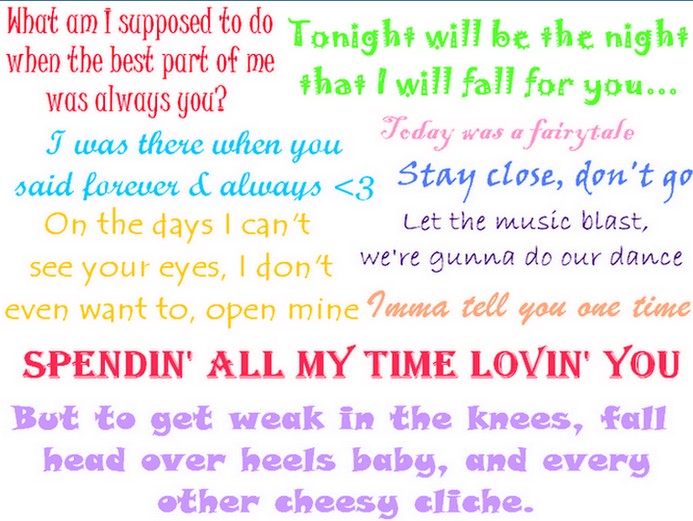
:D
Author's Note: This is what I made instead of doing my homework the other night. Haha it's a jumble of some of my favorite quotes. :)

Life Without Purpose
To read my essay response to Graham Greene's novel, The Power and the Glory, visit my essay blog. The link is at the top of my blog, and be sure to give me your feedback.
Thanks :)
-Taylor
Thanks :)
-Taylor
Monday, April 26, 2010
Human or Animal?
Author's Note: Here is a response to Graham Greene's novel The Power and the Glory. This is a response regarding the mestizo -- a traitor who lives the life of an animal.
With two fanged teeth and an animal like personality to match, the mestizo represents what it truly means to live like a dog. Sleeping in jail cells as if they are a hotel, perfectly comfortable laying next to his own vomit, and being known as a modern day Judas, this life is not a life which we would be proud to live, for only an animal would have the patience to put up with it.
While running from the government, the priest encounters this mestizo and spends the night with him while camping out in a nearby hut. From the start the priest, "was determined not to sleep -- the man had some plan…He knew. He was in the presence of Judas." (p. 91) It is clear the mestizo is going to end up in the layer of hell with those who do not stand up for something in their life, for revolving your life around yourself and never actually standing up for something, is a waste of a life and that person never really deserved to live at all. The animal like life which the mestizo lives is not a life which we would ever want to even consider living for those who betray, those who never stand up for something, and those who are okay with these sins, never deserved life in the first place.
With two fanged teeth and an animal like personality to match, the mestizo represents what it truly means to live like a dog. Sleeping in jail cells as if they are a hotel, perfectly comfortable laying next to his own vomit, and being known as a modern day Judas, this life is not a life which we would be proud to live, for only an animal would have the patience to put up with it.
While running from the government, the priest encounters this mestizo and spends the night with him while camping out in a nearby hut. From the start the priest, "was determined not to sleep -- the man had some plan…He knew. He was in the presence of Judas." (p. 91) It is clear the mestizo is going to end up in the layer of hell with those who do not stand up for something in their life, for revolving your life around yourself and never actually standing up for something, is a waste of a life and that person never really deserved to live at all. The animal like life which the mestizo lives is not a life which we would ever want to even consider living for those who betray, those who never stand up for something, and those who are okay with these sins, never deserved life in the first place.
Thursday, April 22, 2010
Religous Traitors
Author's Note: In the novel The Power and the Glory, religion is not only frowned upon, it is considered illegal. This response is talking about the power of religion and with it banned, people now have to find a new "crutch" to turn to in their time of need.
When living in an ironic world where nothing seems to be going the way you planned, what would you turn to for reasurrance and comfort? With billions of people in the world, it is clear that not everyone is going to like us, but when we stand up for something we truly believe in, these opinions don't seem to matter much at all. Throughout the course of the novel The Power and the Glory, characters are tested and true personalities are revealed as the controlling government decides what will be considered right and what will be considered wrong.
Religion is thought to be one of the main crutches in todays society, for when everything seems to be going wrong we can always turn to God and know that things will all work out in the end. However now that religion is illegal, and priests turn to traiters, would we have the guts to stand up for our beliefs? Having priests turn against their own religion is exactly what the government was hoping would happen as if they are telling them that they do not need religion, that they are the only leaders they need in order to survive.
When living in an ironic world where nothing seems to be going the way you planned, what would you turn to for reasurrance and comfort? With billions of people in the world, it is clear that not everyone is going to like us, but when we stand up for something we truly believe in, these opinions don't seem to matter much at all. Throughout the course of the novel The Power and the Glory, characters are tested and true personalities are revealed as the controlling government decides what will be considered right and what will be considered wrong.
Religion is thought to be one of the main crutches in todays society, for when everything seems to be going wrong we can always turn to God and know that things will all work out in the end. However now that religion is illegal, and priests turn to traiters, would we have the guts to stand up for our beliefs? Having priests turn against their own religion is exactly what the government was hoping would happen as if they are telling them that they do not need religion, that they are the only leaders they need in order to survive.
Thursday, April 8, 2010
Forever and Always
Author's Note: Here is a poem type response to Nicholas Spark's novel Dear John. This is written in Savannah's point of view and is a visual of what their time was like together right after they met. It was love at first sight for John and Savannah and this entry shows that connection that they shared.


Saturday, April 3, 2010
Breakup Letter Re-write
Author's Note: Here is my version of the breakup letter from Nicholas Sparks novel, Dear John. This letter is written from Savannah's point of view as she writes a letter to John, who is currently in Iraq. This is the letter that puts an end to their relationship and explains why it is time for her to end it.
Dear John,
With all that we have been through together, it is hard for me to gather my thoughts and spill them out onto paper, especially with these countless tears running down my cheeks. I understand if you hate me, and if you never wish to speak to me again because right now, part of me hates me too. When I look in the mirror, I feel your presence with me, looking down on me for the choices I made and I feel that I do not deserve to be loved at all. Before I decided to write this letter I spent a lot of time trying to make sense of my thoughts and right now all I know is how much you mean to me and just how much I am going to miss you.
I know this is a terrible time for you and as I sit here I try to imagine what exactly life is like for you right now. I pray for you each and every night, and I always will. No matter how much things may change, I want you to know that. We have had our ups and downs throughout the last two and a half years, and with you gone overseas it seems we have more downs now than ever before. I long to be with you once again, and to be able to relieve the events from last summer: the times on the beach, the times I spent in your arms, and the countless memories. You and I shared someone wonderful and to me that means our souls will be linked together forever. But as we both know, things have changed John. With you gone all the time, I feel I have no one else to turn to, I cry myself to sleep at night and try to imagine you next to me, like the night we spent together so long ago. I hate myself for saying this, but I feel it is time to tell you, instead of letting this go on any longer and believe me I did not mean to fall in love with someone else.
I myself do not even know how it happened, so there is no possible way for me to expect you to. I am truly sorry and I should have done he right thing and told you a long time ago, but I could never find the heart to do so. Part of me wishes you could be here with me now so this could have been done in person, but as we both know that is not possible, so I guess this is how it has to be. No matter what the future may bring, you will always be my first true love John, and I believe I am the person I am because of it.
Please forgive me,
With all that we have been through together, it is hard for me to gather my thoughts and spill them out onto paper, especially with these countless tears running down my cheeks. I understand if you hate me, and if you never wish to speak to me again because right now, part of me hates me too. When I look in the mirror, I feel your presence with me, looking down on me for the choices I made and I feel that I do not deserve to be loved at all. Before I decided to write this letter I spent a lot of time trying to make sense of my thoughts and right now all I know is how much you mean to me and just how much I am going to miss you.
I know this is a terrible time for you and as I sit here I try to imagine what exactly life is like for you right now. I pray for you each and every night, and I always will. No matter how much things may change, I want you to know that. We have had our ups and downs throughout the last two and a half years, and with you gone overseas it seems we have more downs now than ever before. I long to be with you once again, and to be able to relieve the events from last summer: the times on the beach, the times I spent in your arms, and the countless memories. You and I shared someone wonderful and to me that means our souls will be linked together forever. But as we both know, things have changed John. With you gone all the time, I feel I have no one else to turn to, I cry myself to sleep at night and try to imagine you next to me, like the night we spent together so long ago. I hate myself for saying this, but I feel it is time to tell you, instead of letting this go on any longer and believe me I did not mean to fall in love with someone else.
I myself do not even know how it happened, so there is no possible way for me to expect you to. I am truly sorry and I should have done he right thing and told you a long time ago, but I could never find the heart to do so. Part of me wishes you could be here with me now so this could have been done in person, but as we both know that is not possible, so I guess this is how it has to be. No matter what the future may bring, you will always be my first true love John, and I believe I am the person I am because of it.
Please forgive me,
Savannah
Friday, March 26, 2010
Love or Country
Author's Note: Here is a quick introductory response to Nicholas Spark's novel Dear John. In this response I introduce the two main characters and give a little background info to how the novel was put together and the time period in which it takes place.
For our independent novel, Morgan and I are reading Nicholas Spark's romantic novel Dear John. Even though we are only about 55 pages into the novel, the theme is clear: love. Nicholas is famous for his other novels such as The Notebook, A Walk to Remember and The Last Song, showing how much of a romantic writer he really is. Dear John was written in 2006 but takes place around 9/11, forcing the main character of the novel, John Tyree, to make a choice no soldier would want to make: love or his country. After meeting Savannah, a college girl vacationing for spring break, he knows that he has just met someone he will never forget. Realizing that he is only on leave for a few weeks, John knows that he is going to have to make a choice; Savannah, or the military. Upon returning to North Carolina, John will discover that "love can transform us in ways we could have never imagined." Although Dear John, isn't exactly a difficult read, we are able to read between the lines and see what we can all uncover.
For our independent novel, Morgan and I are reading Nicholas Spark's romantic novel Dear John. Even though we are only about 55 pages into the novel, the theme is clear: love. Nicholas is famous for his other novels such as The Notebook, A Walk to Remember and The Last Song, showing how much of a romantic writer he really is. Dear John was written in 2006 but takes place around 9/11, forcing the main character of the novel, John Tyree, to make a choice no soldier would want to make: love or his country. After meeting Savannah, a college girl vacationing for spring break, he knows that he has just met someone he will never forget. Realizing that he is only on leave for a few weeks, John knows that he is going to have to make a choice; Savannah, or the military. Upon returning to North Carolina, John will discover that "love can transform us in ways we could have never imagined." Although Dear John, isn't exactly a difficult read, we are able to read between the lines and see what we can all uncover.
Wednesday, March 10, 2010
Subscribe to:
Posts (Atom)